

Merino wool weight guide: 140, 210 or 300 g/m² for winter?
On the label of a merino wool garment, one number always appears: 140, 210 or 300 g/m². This figure, the merino wool weight, is the best indicator of how warm a piece is. Yet it is often misunderstood, and it is one of the main reasons people end up overdressed when ski touring or frozen on a chairlift.
This guide explains how to read fabric weight, which temperatures each weight suits, and how to combine them to stay at the right comfort level all winter.
What exactly is merino wool weight?
Fabric weight indicates how heavy the fabric is, in grams per square metre (g/m², often written gsm). The higher it is, the denser and thicker the knit, the more air it traps, and therefore the better it insulates. A 140 g/m² merino is thin and light, like a technical T-shirt. A 300 g/m² merino is a dense, generous knit that you wear like a jacket.
Fabric weight tells you nothing, however, about how soft the wool is. For that, you need to look at another number.
Weight and fineness: two measurements not to confuse
Fineness is measured in microns: it is the diameter of each wool fibre. The smaller it is, the softer the wool and the less it itches. Standard wool fibres often exceed 25 microns; the merino used for technical clothing goes below 19.5 microns.
The two measurements are independent. A thick 300 g/m² knit can be made from a very fine fibre and stay comfortable against the skin. Conversely, a lightweight fabric knitted from a coarse fibre can prickle. On our merino wool base layers and jackets, fineness stays below 19.5 microns, whatever the weight.
140 g/m²: the lightweight layer, for intense effort and the shoulder season
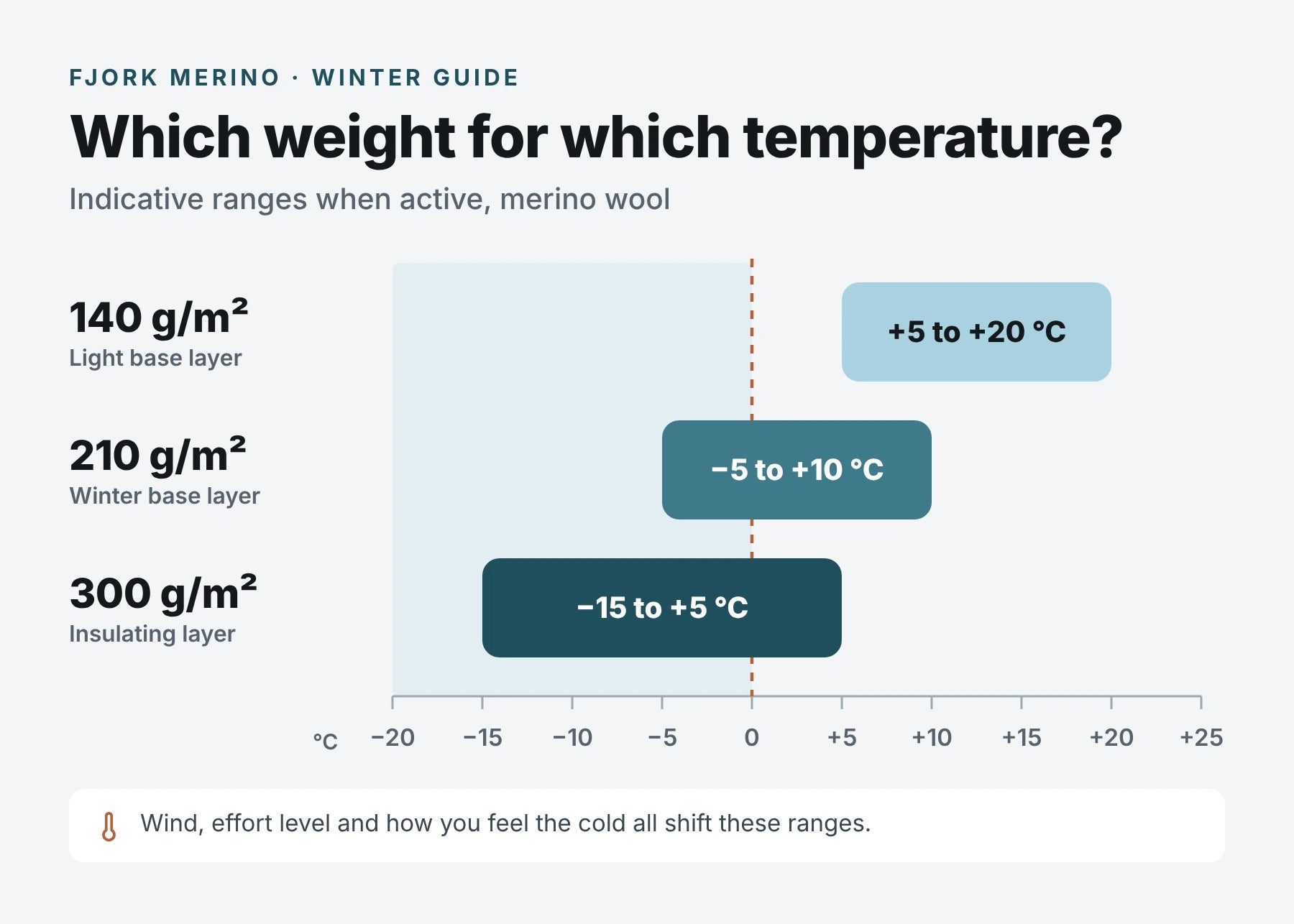
The 140 g/m² weight is the lightest in our range. It covers roughly +5 to +20 °C when active. In winter, it has its place in three situations:
- endurance sports in cold weather, where you produce a lot of heat: cross-country skiing, skate skiing, winter running;
- skinning uphill when ski touring in mild weather or in spring;
- late-season downhill skiing, under a light jacket.
The long-sleeved men's Finn ML 140 and women's Bjork ML 140, in 100% merino wool, are the benchmark pieces at this weight.
210 g/m²: the benchmark for skiing
The 210 g/m² weight is the all-round winter choice. It covers roughly −5 to +10 °C when active and suits most days of downhill skiing, snowshoeing or ski touring in cold weather. Warm enough for lift rides, breathable enough for the descents, it is the base layer to go for if you could only choose one.
The 210 g/m² range covers top and bottom: crew neck (Finn 210, Bjork 210), zip neck (Finn Zip 210, Bjork Zip 210), roll neck (Finn Roll 210, Bjork Roll 210) and full-length or 3/4 leggings.
300 g/m²: the insulating layer for deep cold
At 300 g/m², merino wool changes role: it is no longer a base layer but an insulating mid layer. It covers roughly −15 to +5 °C. Its dense knit retains heat while letting water vapour through, which avoids the ‘pressure cooker’ effect of a synthetic fleece.
The men's Ultra 300 jacket and the women's Ultra 300 jacket (96% merino wool, 4% elastane for freedom of movement) are worn under a ski jacket in deep cold, or on their own in dry weather: on ski touring descents, snowshoeing, in town or at the chalet.
Choosing by how hard you work
Temperature ranges are not enough: at the same temperature, a ski tourer skinning uphill produces far more heat than a parent waiting at the bottom of the slope. A simple rule helps you choose:
- The more you move, the lighter the weight should be. Cross-country, skate skiing, skinning uphill: 140 g/m², or 210 g/m² in deep cold.
- Stop-start effort (downhill skiing, snowboarding): 210 g/m², plus a mid layer depending on the temperature.
- Static activity (waiting, spectating, slow walks, outdoor work): 210 g/m² and 300 g/m² layered together.
Your personal sensitivity counts too: if you feel the cold easily, go up one weight.
Combining weights
The real strength of merino wool is that it can be layered without losing breathability. A few proven combinations:
- Downhill skiing, typical winter: 210 g/m² + ski jacket. Add a down jacket or a 300 g/m² jacket below −10 °C.
- Ski touring: 140 or 210 g/m² on the way up, a 300 g/m² jacket or down jacket put on at the top for the descent. Details in our guide what to wear ski touring.
- Static deep cold: 210 g/m² top and bottom + 300 g/m² jacket + down jacket.
Key takeaways
| Weight | Indicative range | Role | Uses |
|---|---|---|---|
| 140 g/m² | +5 to +20 °C | Lightweight base layer | Cross-country skiing, running, skinning uphill, spring |
| 210 g/m² | −5 to +10 °C | Winter base layer | Downhill skiing, snowshoeing, ski touring in cold weather |
| 300 g/m² | −15 to +5 °C | Insulating mid layer | Deep cold, ski touring descents, static activities |
Every piece is listed by weight in the ski collection.
Frequently asked questions
Is 210 g/m² too warm for ski touring?
In deep cold, no. In mild weather or in spring, 140 g/m² is more comfortable on the way up, as it releases heat better. Many ski tourers set off in 140 g/m² and keep a warm layer in their pack for the descent.
Can you wear 300 g/m² in town?
Yes. A 300 g/m² merino jacket works very well in town, on its own in dry weather or under a light coat. It stays breathable on public transport and in heated shops, where a synthetic fleece quickly makes you sweat.
Is a heavier weight more hard-wearing?
A denser knit resists abrasion slightly better, but lifespan depends mostly on care: wash at 30 °C maximum, on a wool cycle, without fabric softener or tumble dryer. Well looked after, a merino garment keeps its properties for many seasons, whatever its weight.

