

Ski thermals: why choose a merino wool base layer for skiing
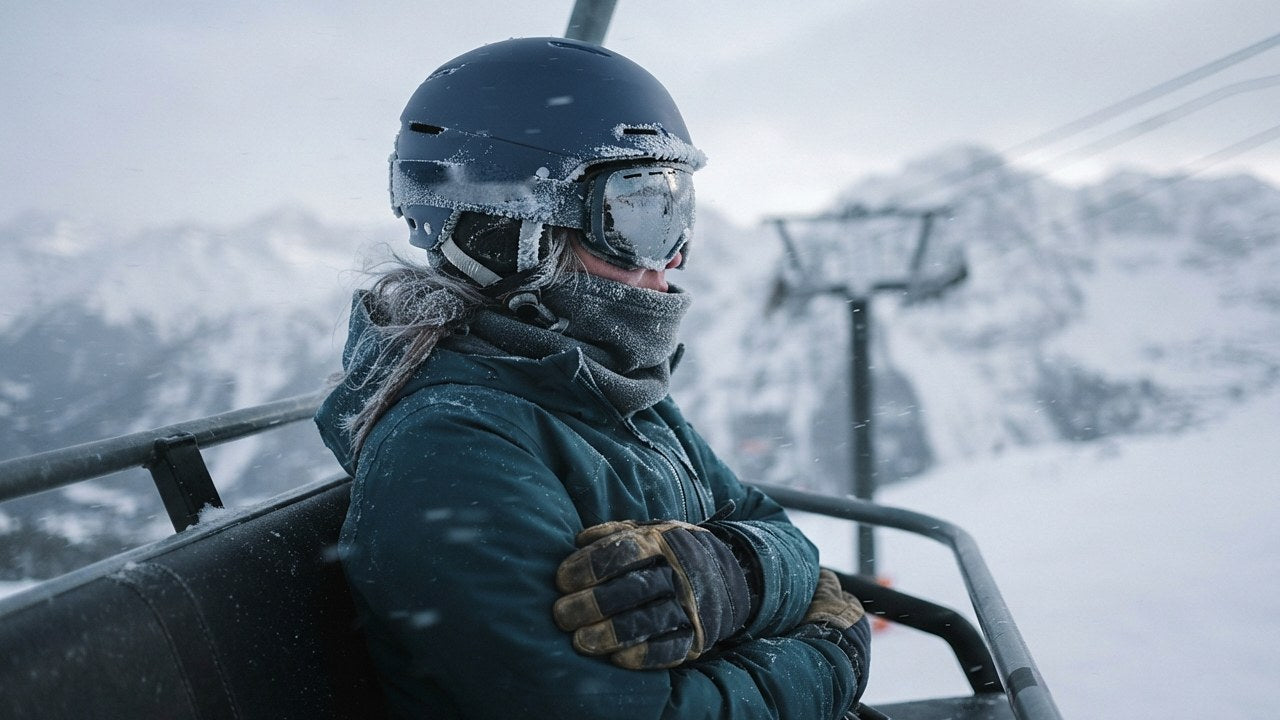
A fast run, a few hard-carved turns, then ten minutes on the chairlift facing the wind. This is exactly when the comfort of your ski day is decided. If your skin is damp, the cold sets in within minutes, and it does not leave. The garment that settles it is not your jacket. It is your ski thermals: the base layer worn directly against your skin.
Merino, synthetic or cotton: here is what really happens under your jacket, and how to choose a merino base layer for skiing that keeps you warm from the first chairlift to the last.
What ski thermals are really for
Despite the name, thermals do not produce heat. They create and maintain a dry microclimate against your skin. Your body supplies the heat; the fabric's job is to stop the moisture from sweat carrying it away.
Skiing makes this particularly difficult, because the effort comes in bursts. You produce a lot of heat and water vapour on the way down, and almost none on the chairlift. A good thermal base layer therefore has to manage moisture while you work and keep insulating at rest, even when slightly damp.
Merino, synthetic, cotton: what happens on the chairlift
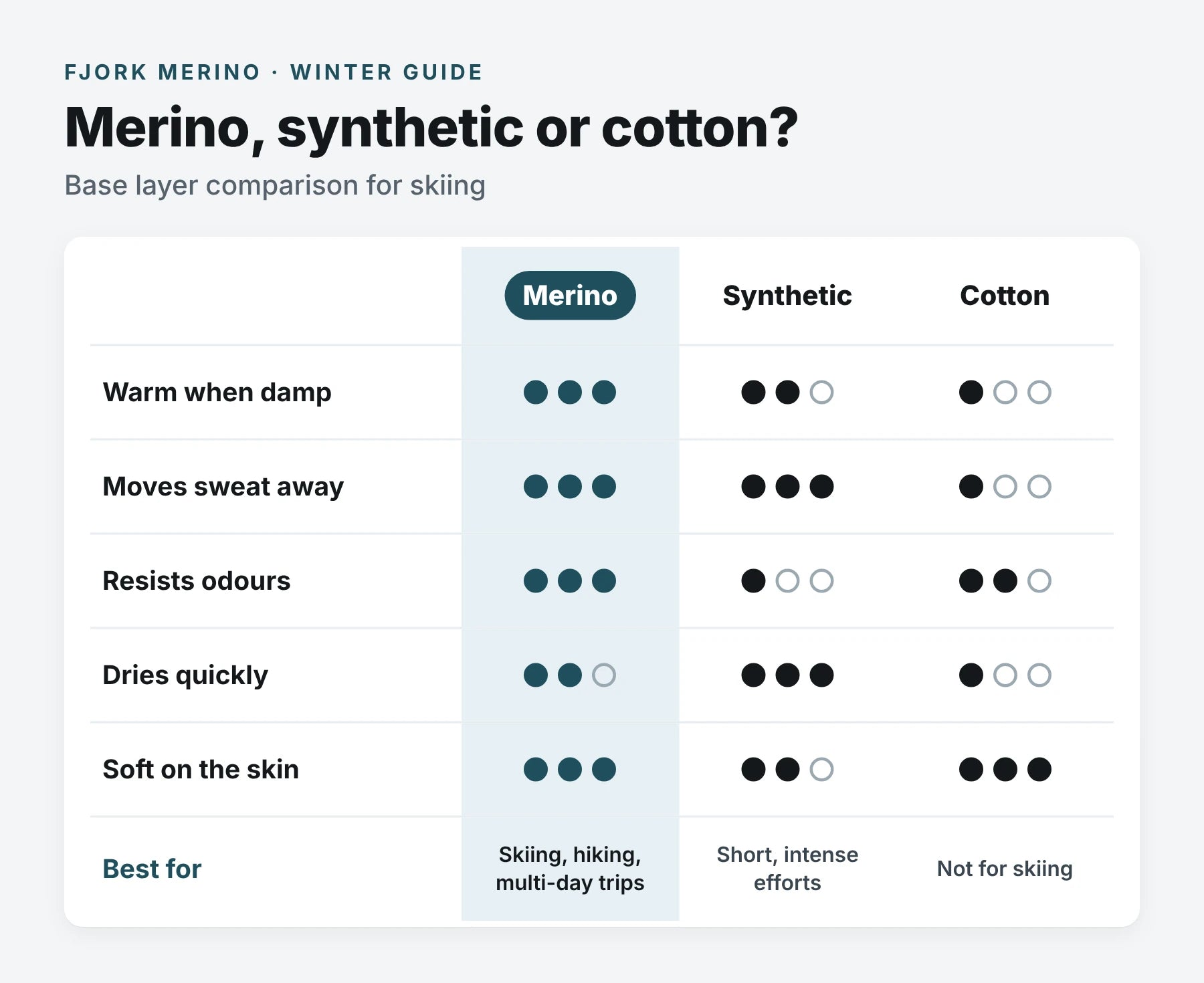
Cotton absorbs large amounts of water and holds on to it. Once wet, it clings to the skin and loses most of its insulating ability. On the chairlift, that water evaporates and cools your body continuously. Cotton has no place in a ski outfit, neither as a T-shirt nor as underwear.
Synthetics (polyester, polypropylene) absorb very little water. They move sweat outwards and dry quickly, a real asset for short, intense efforts. Once saturated, however, they feel cold and clammy against the skin, and they quickly hold on to odours.
Merino wool works differently. The fibre can absorb a significant amount of water vapour within its structure without the surface feeling wet. As it absorbs this moisture, the wool even releases a little heat, a physical phenomenon called heat of sorption. Above all, it retains much of its insulating ability when damp. That is exactly what you need when you go from effort to rest.
Odour, the underrated factor on a ski week
During a week's ski holiday, odour quickly becomes a practical question. Synthetic fibres offer a surface on which odour-causing bacteria grow easily: after a day of effort, a polyester top usually needs washing.
Merino wool resists odours much better. A merino top aired overnight on the back of a chair can be worn several days in a row without any problem. The result: fewer items in your suitcase, less washing at the chalet, and a base layer that always feels fresh.
Choosing a merino base layer for skiing
Fabric weight
For downhill skiing, 210 g/m² is the best compromise. It insulates enough for cold mornings and lift rides, while staying breathable on the descents. The 140 g/m² weight suits spring skiing, cross-country skiing and people who always run warm. To go further, read our merino wool weight guide: 140, 210 or 300 g/m².
Fibre fineness
Wool that itches is almost always wool that is too coarse. Below 19.5 microns in diameter, merino fibre is fine enough to bend against the skin instead of prickling it. This is the fineness we use for all our base layers.
Neckline
- Crew neck: the most versatile, easy to layer. Men's Finn 210, women's Bjork 210.
- Zip neck: open it while you work hard, close it on the chairlift to protect your neck. Finn Zip 210, Bjork Zip 210.
- Roll neck: maximum neck protection in deep cold, and real style for après-ski. Finn Roll 210, Bjork Roll 210.
Fit
A base layer should be close-fitting without constricting. It needs to stay in contact with the skin to pick up moisture, while leaving your shoulders and arms completely free. If you are between two sizes, choose the one that hugs your body without pulling.
Bottoms: full-length or 3/4 leggings?
Merino leggings matter as much as the top, and they are often forgotten. They come in two lengths, for two uses:
- 3/4 leggings stop below the knee, above the cuff of your ski boot. No creases in the boot, no pressure points on the shin: the most comfortable choice for downhill skiing. Men's Finn 210 3/4 leggings, women's Bjork 210 3/4 leggings.
- Full-length leggings protect the whole leg in deep cold, for ski touring or snowshoeing. In the boot, wear your sock over them, lying flat. Men's Finn 210 leggings, women's Bjork 210 leggings.
Care during your ski week
- Air rather than wash: every evening, hang your base layer up in the open air, away from a hot radiator.
- Wash at 30 °C maximum, on a wool cycle, with a mild detergent and no fabric softener.
- No tumble dryer: dry flat, in the open air.
- To protect fine knits in the machine, use a wash bag such as the Wool Care Bag.
Key takeaways
- Thermals do not heat you: they keep your skin dry so your body stays warm.
- Rule out cotton. Synthetics dry fast but feel cold and hold on to odours. Merino insulates even when damp and stays fresh for several days.
- For downhill skiing: 210 g/m² merino, fibre under 19.5 microns, close fit.
- 3/4 leggings for comfort in the boot, full-length leggings for deep cold.
Discover all our base layers in the ski collection.
Frequently asked questions
Does merino wool itch?
Fine merino wool does not itch. The prickly feeling comes from coarse fibres, above roughly 22 to 25 microns. With a fineness below 19.5 microns, the vast majority of people, children included, wear merino directly against the skin without discomfort.
How many thermals do you need for a ski week?
In merino, two tops and one pair of leggings are usually enough for six days: alternate the tops and air them every evening. With synthetics, you need more pieces, because odours mean more frequent washing.
What should you wear under thermals?
Nothing but technical underwear. Avoid cotton briefs, boxers and bras, which keep moisture close to your body. Merino options such as the Strahlorn boxers or the merino sports bra extend the benefits of your base layer.


