

How to dress a child for skiing: a head-to-toe guide
A child who is cold on the slopes often won't tell you straight away. They are absorbed in playing, in ski school, in the piste. By the time they complain, they are already frozen, and the day is over. On the other hand, a child who is wrapped up too warmly sweats during the lesson, then gets cold on the button lift or the chairlift. That is why knowing how to dress a child for skiing takes a little more method than dressing an adult.
Here is our guide, from head to toe, for warm, dry, tear-free days.
Why children get cold faster
Three reasons explain why a child cools down faster than an adult in the same conditions:
- Their body is smaller: relative to their mass, they have more exposed skin and lose heat faster.
- Their effort is irregular: they alternate sprints, falls, waiting at the bottom of the slope and lift rides, with big swings in body temperature.
- They don't manage their clothing: they won't think to open their jacket when they are hot, or to close it on the chairlift.
Their outfit has to do that job for them: manage sweat on its own and insulate even when they stop.
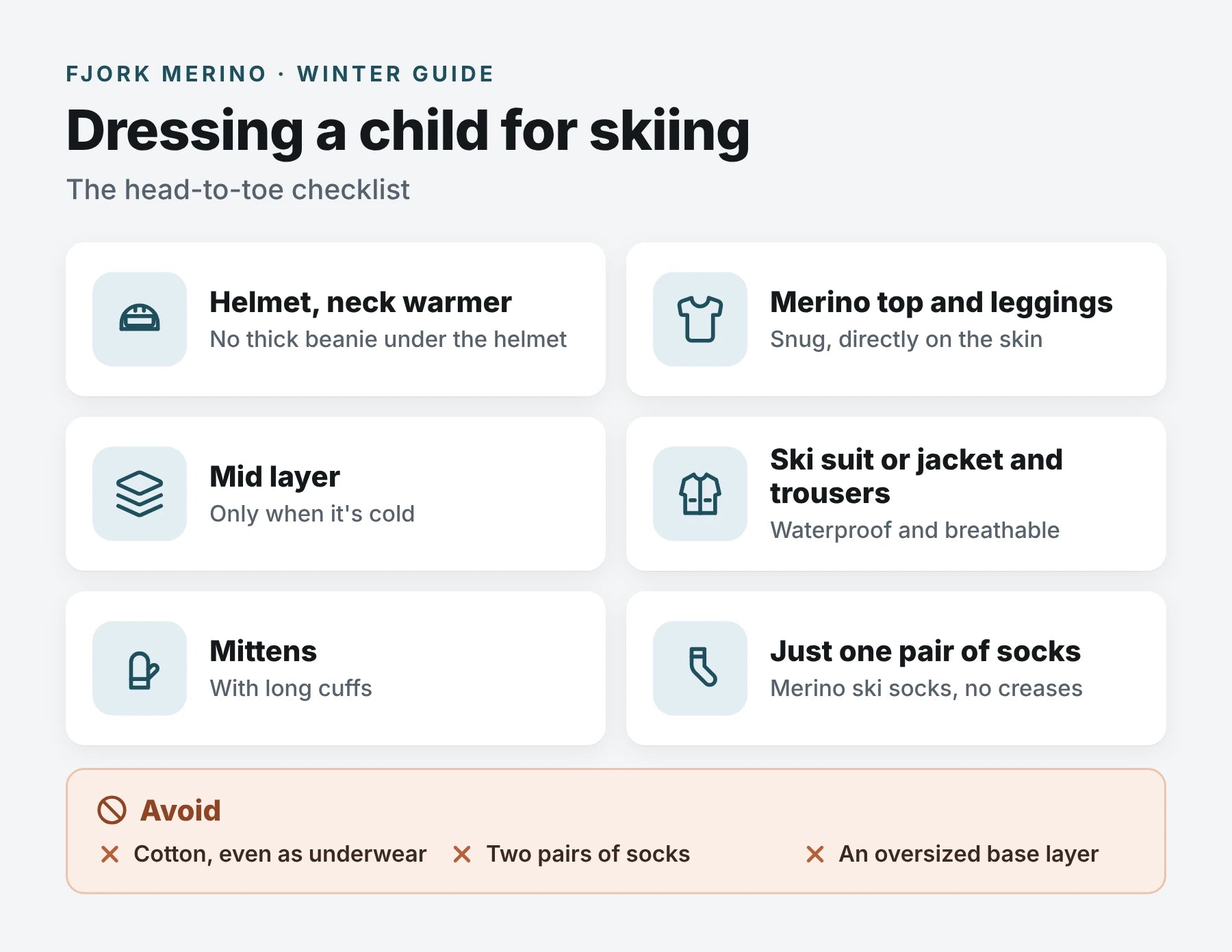
The base layer: a merino top and leggings
As for adults, everything starts with the base layer. It must keep the skin dry, which rules out cotton: a cotton T-shirt soaked with sweat stays wet all day and chills the child at every break.
Merino wool is particularly well suited to children. It absorbs sweat without feeling wet, keeps insulating even when damp and, with a fibre below 19.5 microns, it does not itch sensitive skin. The Kids 210 top and Kids 210 leggings, in 100% merino wool at 210 g/m², form the ideal base for a child's ski outfit. For the youngest, the One Piece Merino 300 Kids covers the whole body in a single piece, with no bare back when the child bends over.
When it comes to size, choose a close-fitting base layer, in contact with the skin. Buying two sizes up ‘so they can grow into it’ backfires: too loose, it lets cold air circulate and manages sweat less effectively.
The mid layer: insulate according to the weather
On a sunny spring day, the base layer and ski jacket are enough. In cold weather, add a mid layer. A heavyweight merino wool jacket such as the Ultra 300 Kids jacket insulates well while staying breathable: your child can sweat in ski school without being soaked by snack time.
Ski suit or jacket and trousers?
For young children, a ski suit has real advantages: no snow down the back after a fall, and quicker dressing. From age 6 or 7, a jacket and trousers become more practical: they can take the jacket off at the restaurant and adapt their outfit to the weather. Either way, the rule is the same: the outer layer must be waterproof and breathable, and the base layer does the thermal work.
Feet: one pair of ski socks
This is the most common mistake, made with the best intentions: putting on two pairs of socks so they won't be cold. The result is the opposite. Squeezed inside the boot, the foot gets less blood flow and cools faster. The creases also create painful pressure points.
- One pair of over-the-calf merino ski socks, such as the Pro Team Ski 90 Kids socks.
- No bunched-up leggings in the boot: they stop above it or go under the sock, lying flat.
- Perfectly dry ski boots every morning: take the liners out in the evening to dry them.
Hands and head
- Mittens rather than gloves: the fingers warm each other, and mittens are much easier for a child to put on. Choose long cuffs that cover the jacket sleeve.
- A helmet is essential. Don't add a thick beanie underneath: it stops the helmet fitting properly. A thin neck warmer protects the neck and lower face.
- A warm beanie for breaks and après-ski, such as the merino wool Pollux beanie.
How to dress a child for skiing: the morning checklist
- Merino top and leggings, directly against the skin, with cotton-free underwear.
- One pair of ski socks, pulled up well, without creases.
- A mid layer depending on the weather.
- Ski suit, or ski jacket and trousers.
- Neck warmer, helmet and goggles.
- Mittens, plus a spare pair in the parent's bag.
- Sun cream and lip protection, even on overcast days.
After skiing: dry, air, wash
In the evening, dry liners, mittens and helmets away from strong heat sources. Merino base layers do not need washing every day: aired on a drying rack, they are ready the next morning, without odour. For washing, use 30 °C maximum and a wool cycle, with no fabric softener and no tumble dryer. A wash bag such as the Wool Care Bag protects fine knits.
Key takeaways
- No cotton: a merino base layer, top and leggings, keeps your child dry.
- A mid layer only when it is cold, and a waterproof outer layer.
- One pair of ski socks, mittens and a neck warmer.
- A close-fitting base layer, neither too big nor too tight.
Find the full range for children in the kids' collection. For the adults in the family, our guide how to dress for skiing: the ski layering system explains the same method.
Frequently asked questions
Can a child wear merino wool directly against the skin?
Yes. Fine merino wool, below 19.5 microns, is soft and does not itch. It suits sensitive skin and can be worn directly against the skin, like ordinary underwear.
How many layers should a child wear for skiing at −10 °C?
Three layers: a merino base layer top and bottom, a warm mid layer such as a heavyweight wool jacket, and a waterproof ski suit or jacket and trousers. Add a neck warmer and mittens, and check regularly that your child is neither cold nor too hot.
How can I tell if my child is cold?
Touch the back of their neck rather than their hands: cold hands are normal, but a cold neck means the body is cooling down. Pale lips, shivering, a drop in energy or grumpiness are also signs that it is time for a warm break.

